Core Functional Capabilities
- Section 2.1 and 2.2 service descriptions from Attachment+0002+DIU+OnRamp+Hub+SOW.pdf
- Team workflow notes and Zoho CRM / Pathfinder / Copilot tool inventory
Discussion Summary
The group discussed how to transform the abstract goal of "lowering barriers" into five concrete, day-to-day operational functions. The team noted that while the hub has historically operated with a heavily event-driven focus, it needs to intentionally pivot toward a structured, data-driven workflow.
They mapped out an end-to-end pipeline for how a company moves through their system—beginning with a wide public awareness engine, stepping through a foundational intake evaluation, moving into active matchmaking against real federal demand signals, receiving maturity transition services, and ultimately gaining access to restricted test sites.
The discussion highlighted a current gap between these core functions and the team's formal job descriptions. Consequently, the operators agreed to reorient their daily tasks over the next 30 to 90 days to master these five workflow areas using their current software tools.
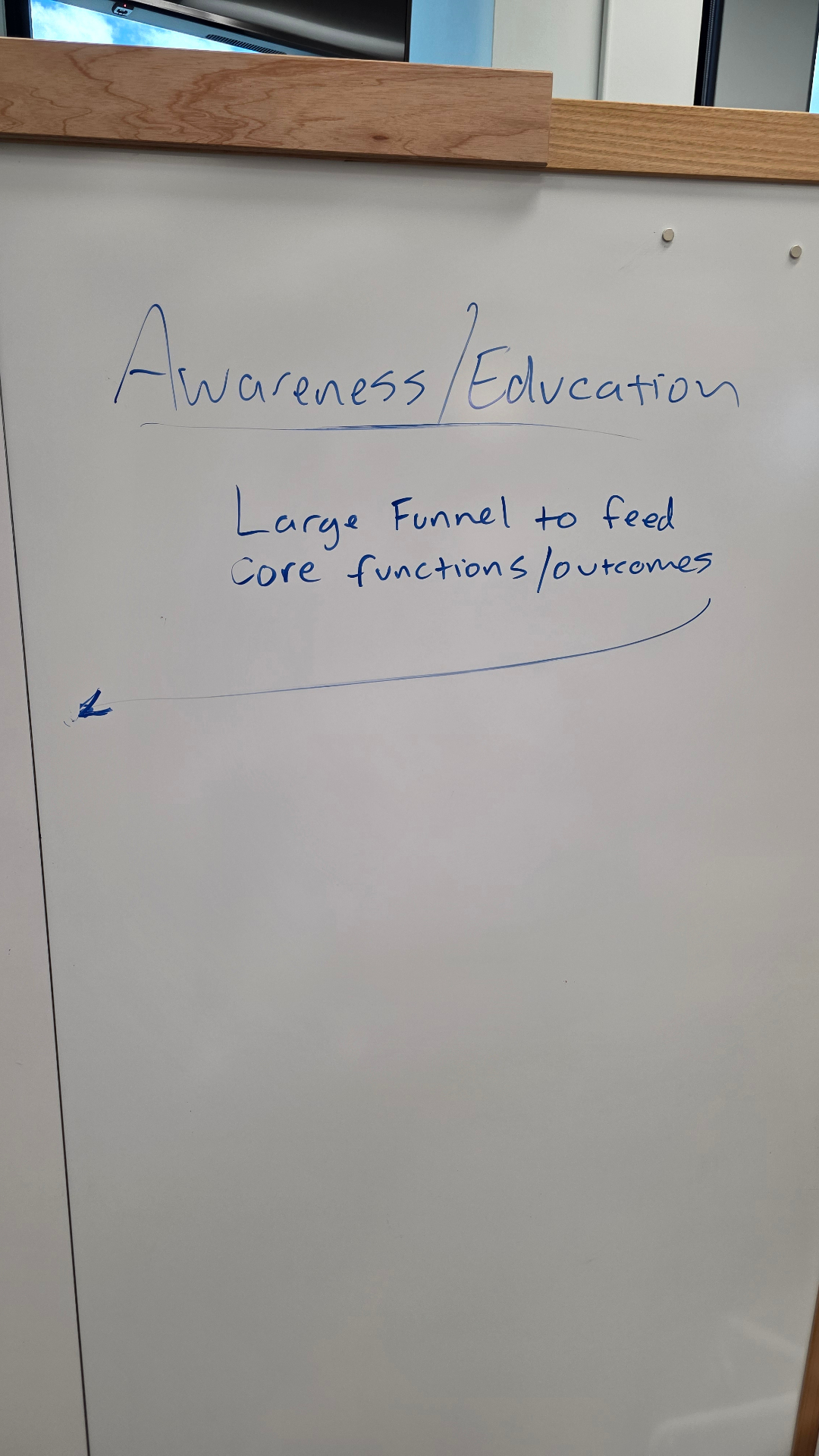
Whiteboard Capture
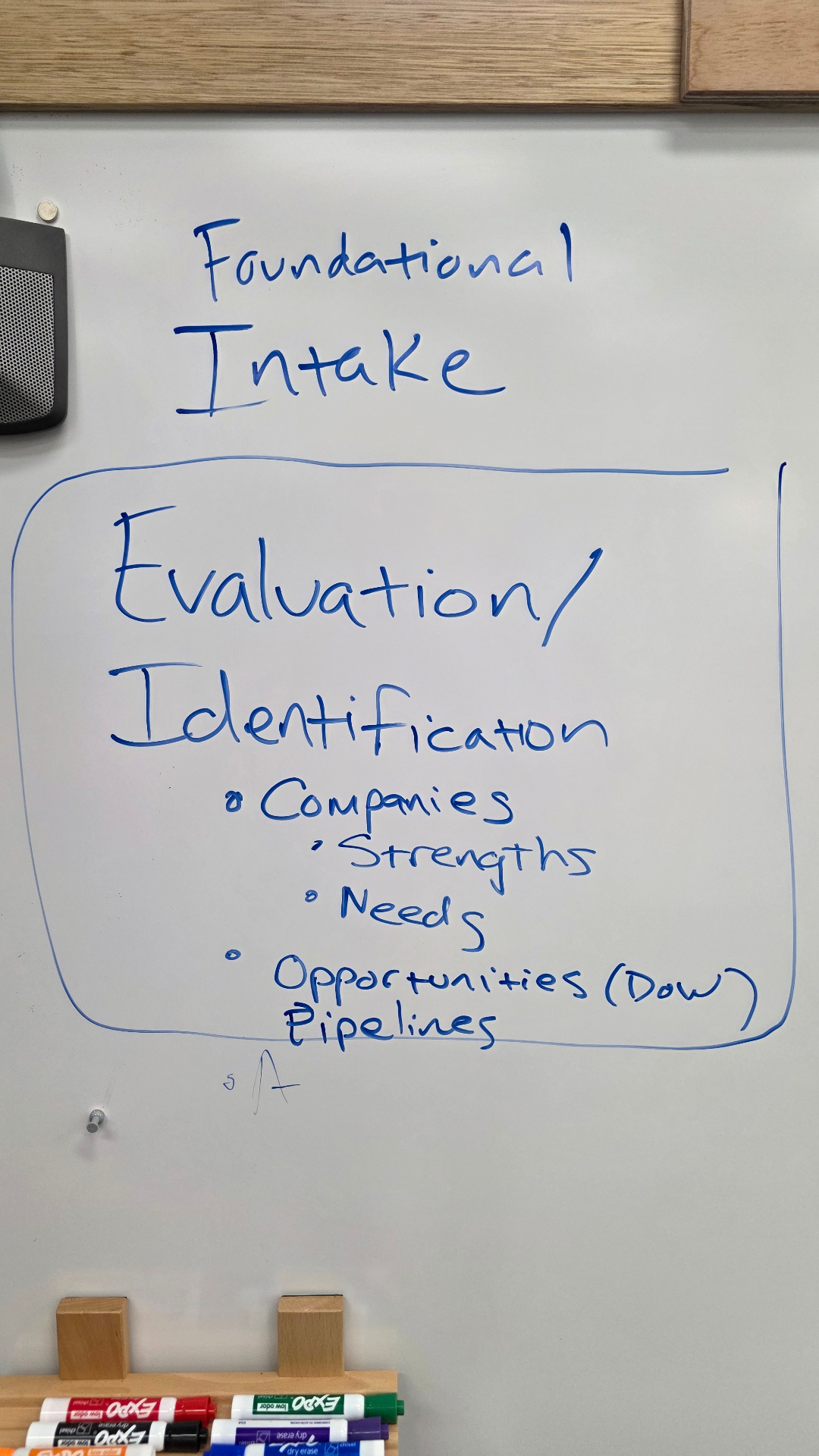
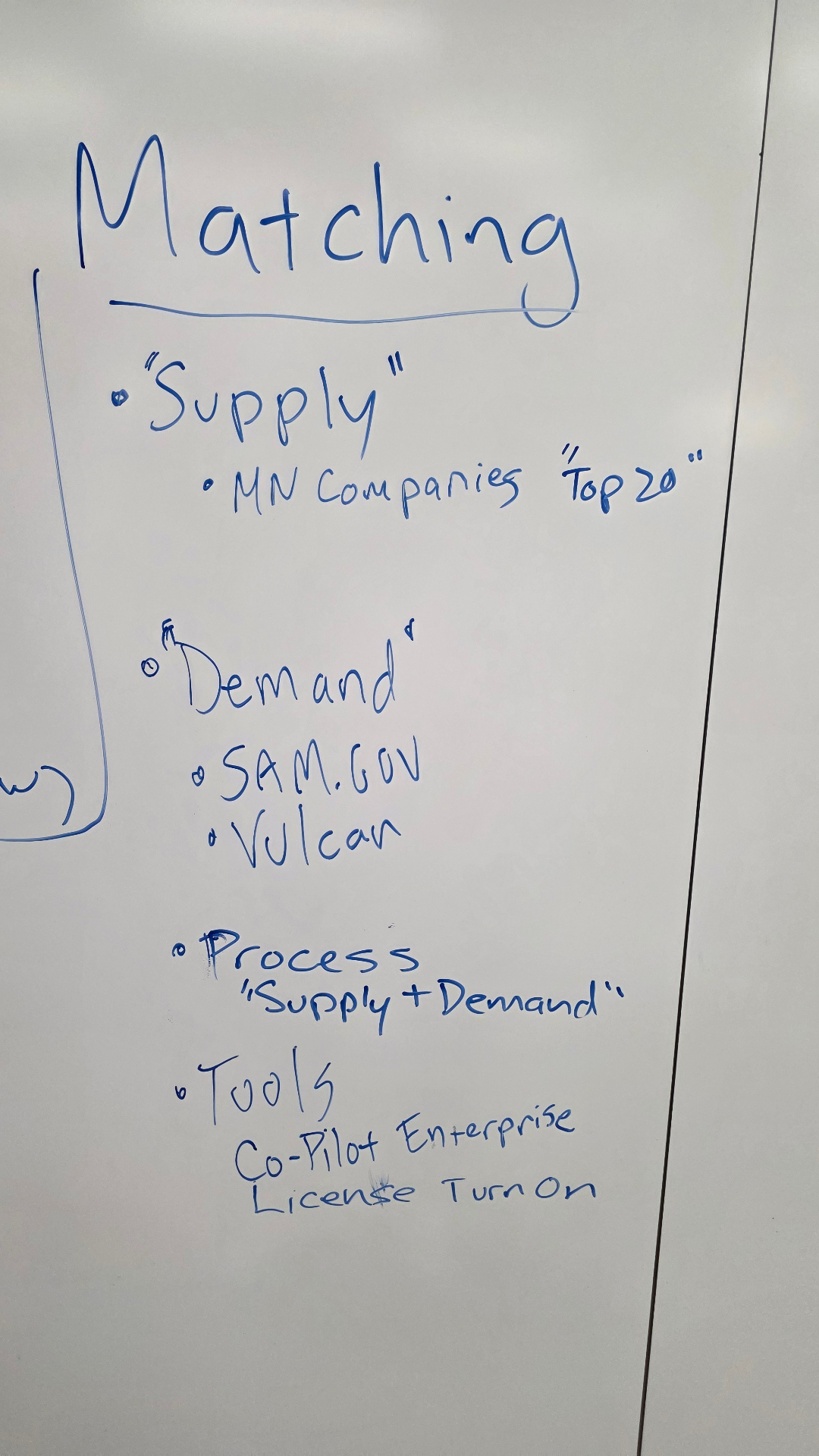
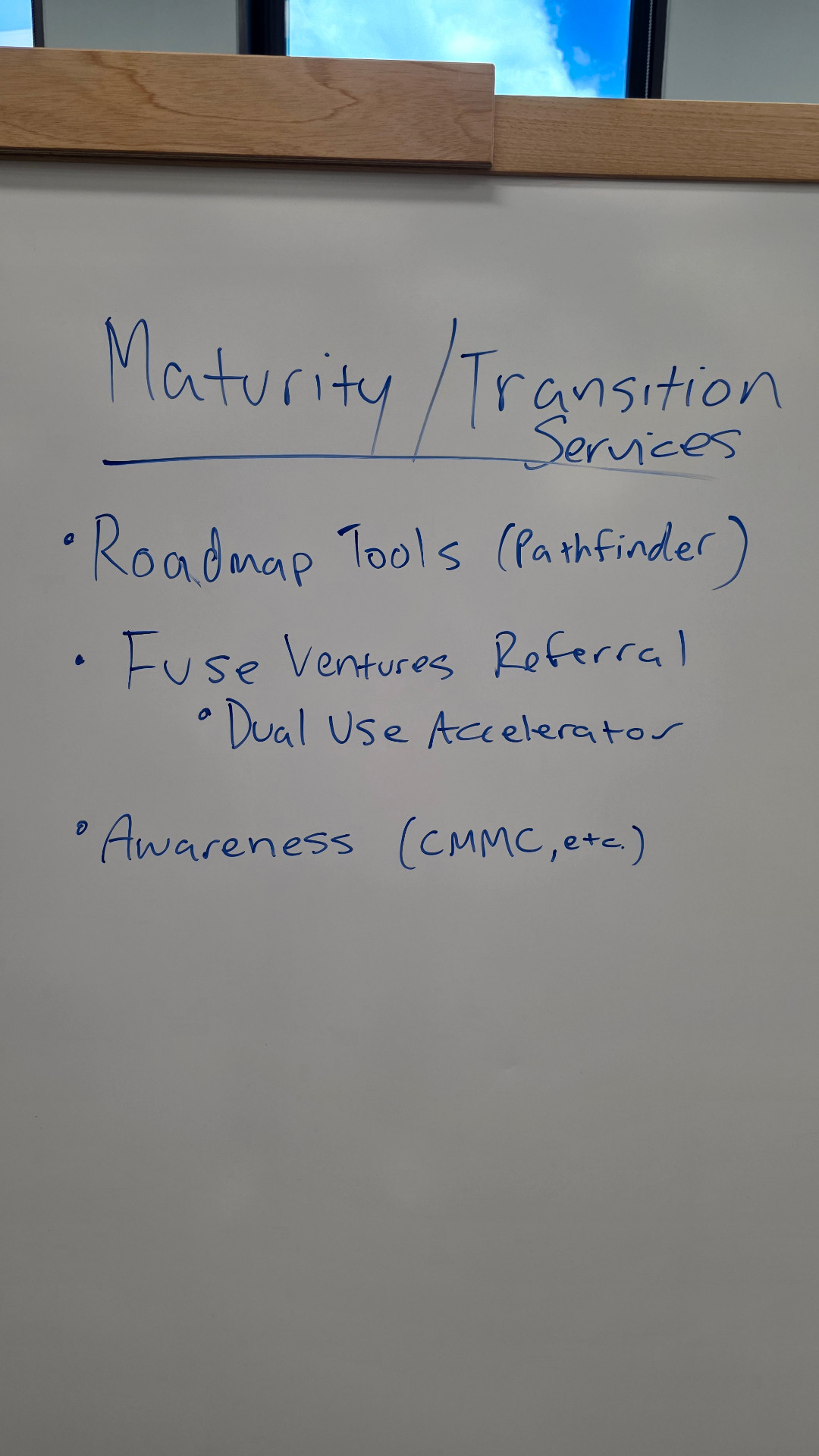
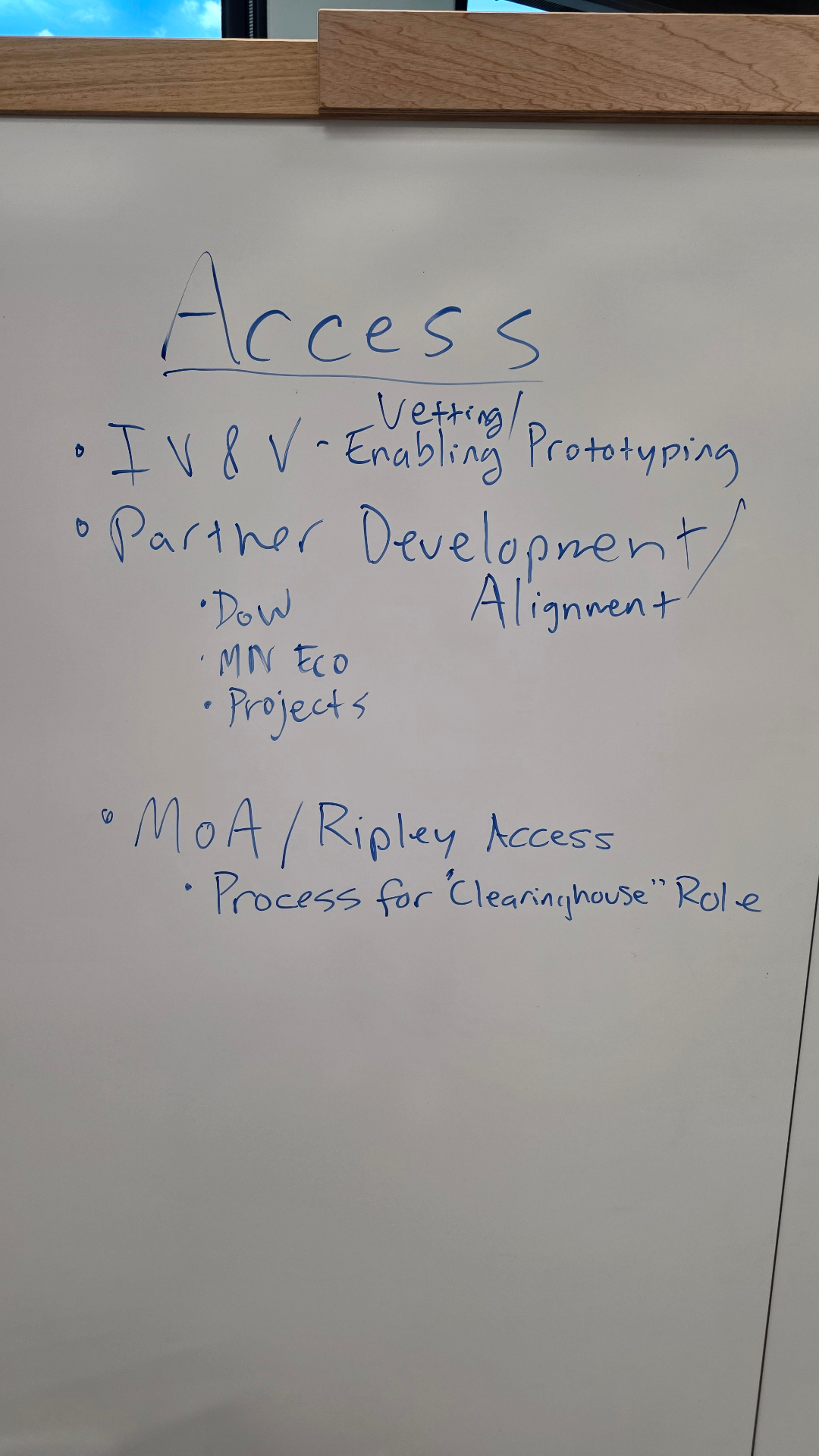
Photos of the five core functional capabilities mapped during the session.
Core Functional Capabilities Profiles
Description, rationale, tools & tactics, and operational next steps for each capability.
- 1
Foundational Intake (Evaluation & Identification)
Description: Uncovering local companies and evaluating their specific technical strengths and operational needs, while simultaneously identifying incoming defense procurement pipelines.
Rationale for Capability: To build an outcome-driven system, the hub cannot rely on passive networking. The team must systematically evaluate which businesses are genuinely ready for defense contracts and identify where their structural gaps lie.
Tools & Tactics Discussed: Conducting formal introductory interviews to review corporate capability briefs, pitch decks, and technical white papers. Tagging and organizing incoming leads by technology readiness levels (TRL) and critical technology sectors inside Zoho CRM.
Operational Next Steps: Because the team currently lacks an automated, integrated digital backbone from national programs, intake remains a manual, interview-based process. The near-term focus is to create standardized intake templates to capture clear keywords from local innovators before moving them into deeper matching phases.
- 2
Matching (Supply & Demand Analysis)
Description: Pairing the "supply side" of prioritized local companies with the "demand side" of active, unclassified government requirements.
Rationale for Capability: This function turns broad ecosystem engagement into targeted business opportunities. Instead of waiting for companies to find contracts on their own, the hub actively isolates a "Top 20" list of mature local businesses and matches them directly against verified federal needs.
Tools & Tactics Discussed: Manually searching federal portals like Sam.gov and Vulcan to download active solicitations and save them internally before they are archived.
Operational Next Steps: The team will immediately turn on and collaborate through an enterprise instance of Microsoft Copilot. By feeding downloaded defense requirements into Copilot, the operators can run automated queries against their internal library of Minnesota company data, creating an immediate 10% improvement in matching speed without waiting for new software procurements.
- 3
Maturity & Transition Services (Roadmapping & Compliance)
Description: Guiding local companies to fix internal operational deficiencies—such as cybersecurity compliance gaps or funding shortages—so they can successfully transition into the defense market.
Rationale for Capability: Promising commercial technology frequently fails to transition to the military because small companies hit sudden regulatory roadblocks, such as upcoming Cybersecurity Maturity Model Certification (CMMC) deadlines.
Tools & Tactics Discussed: Deploying the Pathfinder evaluation tool to run automated risk assessments on local companies, uncovering hidden hurdles like foreign ownership flags or software vulnerabilities.
Operational Next Steps: The hub will focus on delivering practical, step-by-step compliance roadmaps to local businesses. They will also utilize their network connections to refer mature dual-use candidates directly to outside accelerator programs, such as Fuse Ventures, to help companies secure necessary private capital.
- 4
Access (Vetting, Prototyping & Partner Alignment)
Description: Providing commercial companies with physical test locations to validate their prototypes, while opening up direct connections to national defense partners, major prime contractors, and regional infrastructure projects.
Rationale for Capability: Commercial innovators rarely possess the clearances or specialized ranges required to verify that their hardware and software meet strict military conditions. Providing access to these testing grounds makes local prototypes immediately competitive.
Tools & Tactics Discussed: Leveraging a formal Memorandum of Agreement (MOA) with the Minnesota National Guard to establish the hub as a trusted "clearinghouse" that screens and brings vetted commercial companies onto the ranges at Camp Ripley.
Operational Next Steps: Because the hub does not own physical test sites, its value relies on strong partner alignment. Over the next 90 days, the team will schedule site visits to regional facilities like Grand Sky to build a comprehensive testing directory. They will also host private, 90-minute "vertical speed dating" sessions to connect local companies directly with one another to build collaborative joint proposals for large public-private projects like the Minnesota Aerospace Complex.
- 5
Awareness & Education (Outreach & Engagement)
Description: Conducting broad public outreach, regional roadshows, and informational workshops to educate the local commercial ecosystem on how to do business with the defense sector.
Rationale for Capability: This serves as the wide, top-of-the-funnel engine that feeds the entire operational pipeline. Continuous outreach allows the hub to turn over new stones, locate non-traditional commercial capabilities, and change the local public narrative around defense manufacturing.
Tools & Tactics Discussed: Maintaining a professional LinkedIn presence, delivering curated regional roadshows across the state (such as recent stops in Mankato and St. Cloud), and speaking on expert panels at local industrial conferences.
Operational Next Steps: This function has successfully generated a robust database of over 600 individuals and 300 organizations. To prevent staff exhaustion and shift hours toward lower-funnel matching, the team will transition away from planning high-production, labor-intensive public expos in favor of simpler, low-burden virtual roundtables.