Purpose, Vision, & Mission Statements
- Attachment+0002+DIU+OnRamp+Hub+SOW.pdf
- Strategic plan goals from the team building document
Discussion Summary
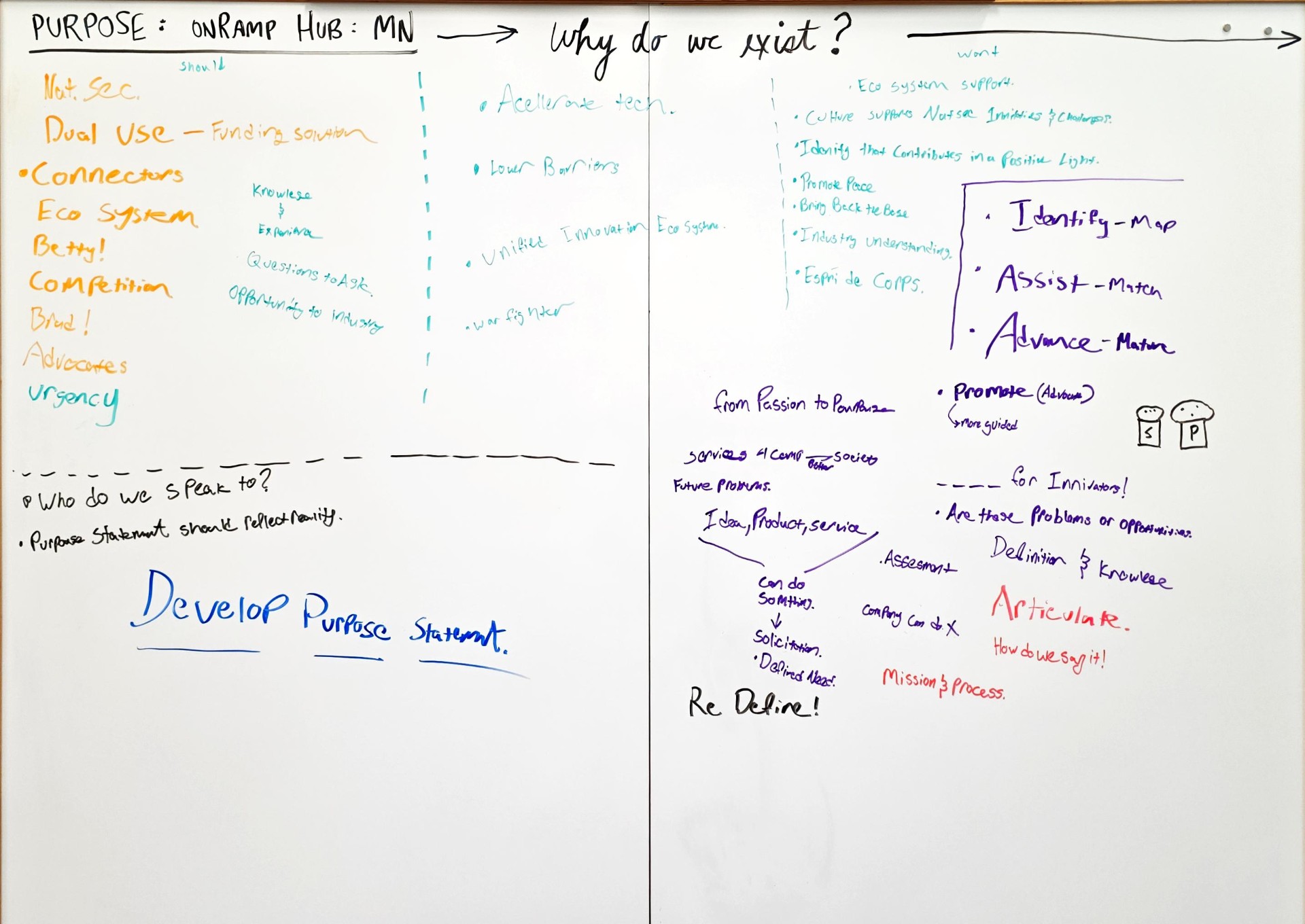
We discussed the core reason our Minnesota hub exists, deciding to move away from the prepackaged national purpose statement because it included high-level outcomes outside our direct control. Our conversation focused on the practical reality of operating in Minnesota—a state with a rich history of commercial innovation (such as 3M, Honeywell, and early computing companies) but no large, active-duty military bases. We talked about acting as an "interpreter" to bridge the gap between our local commercial businesses and the defense market, emphasizing that we must use plain, welcoming language rather than military acronyms or terms like "solicitation" that push non-defense innovators away. We concluded that our actual day-to-day work is to serve as hands-on connectors who find, guide, and promote local commercial ideas, products, and services that can simultaneously expand our state's economy and provide critical protection to service members.
Whiteboard Capture
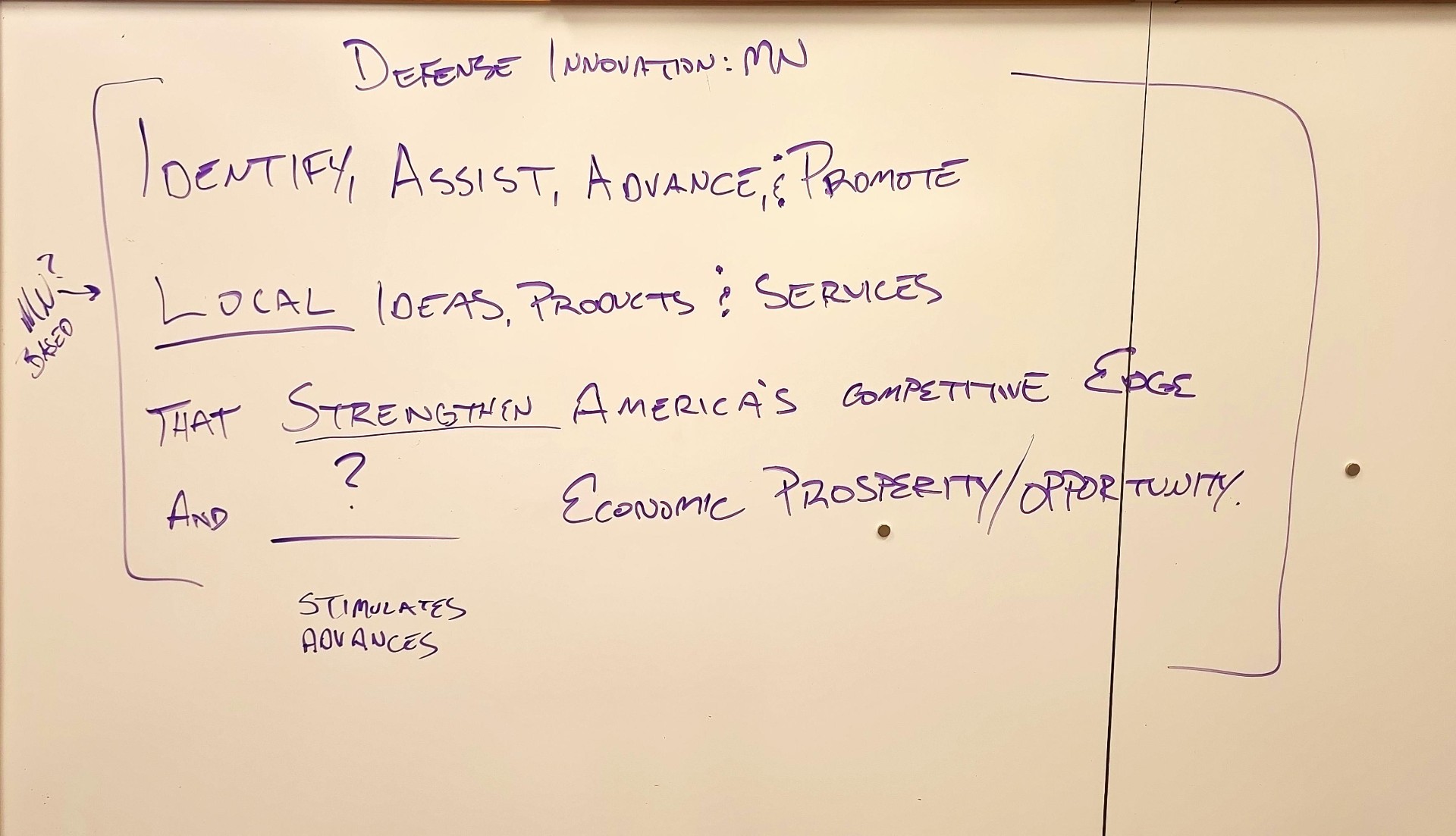
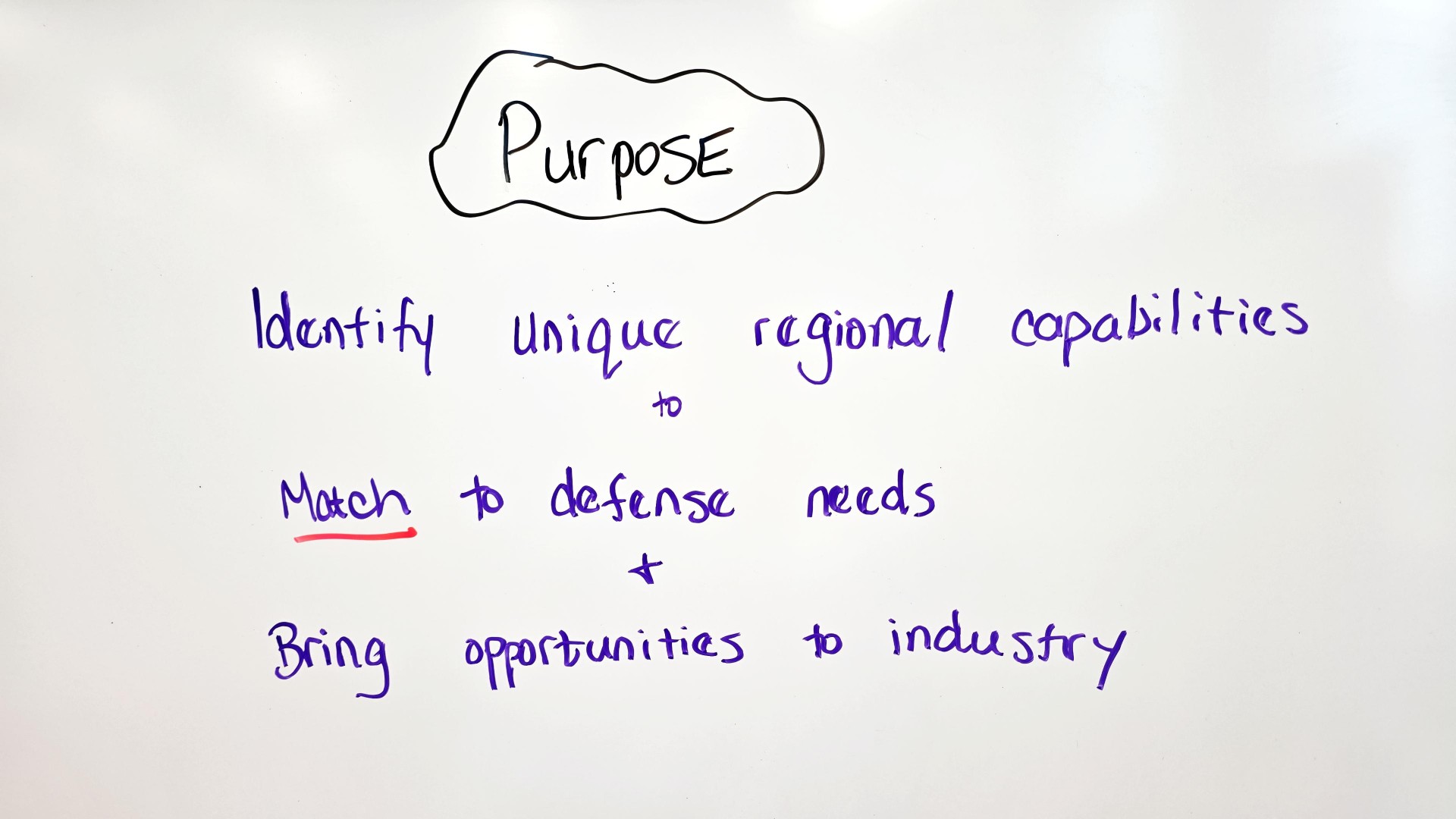
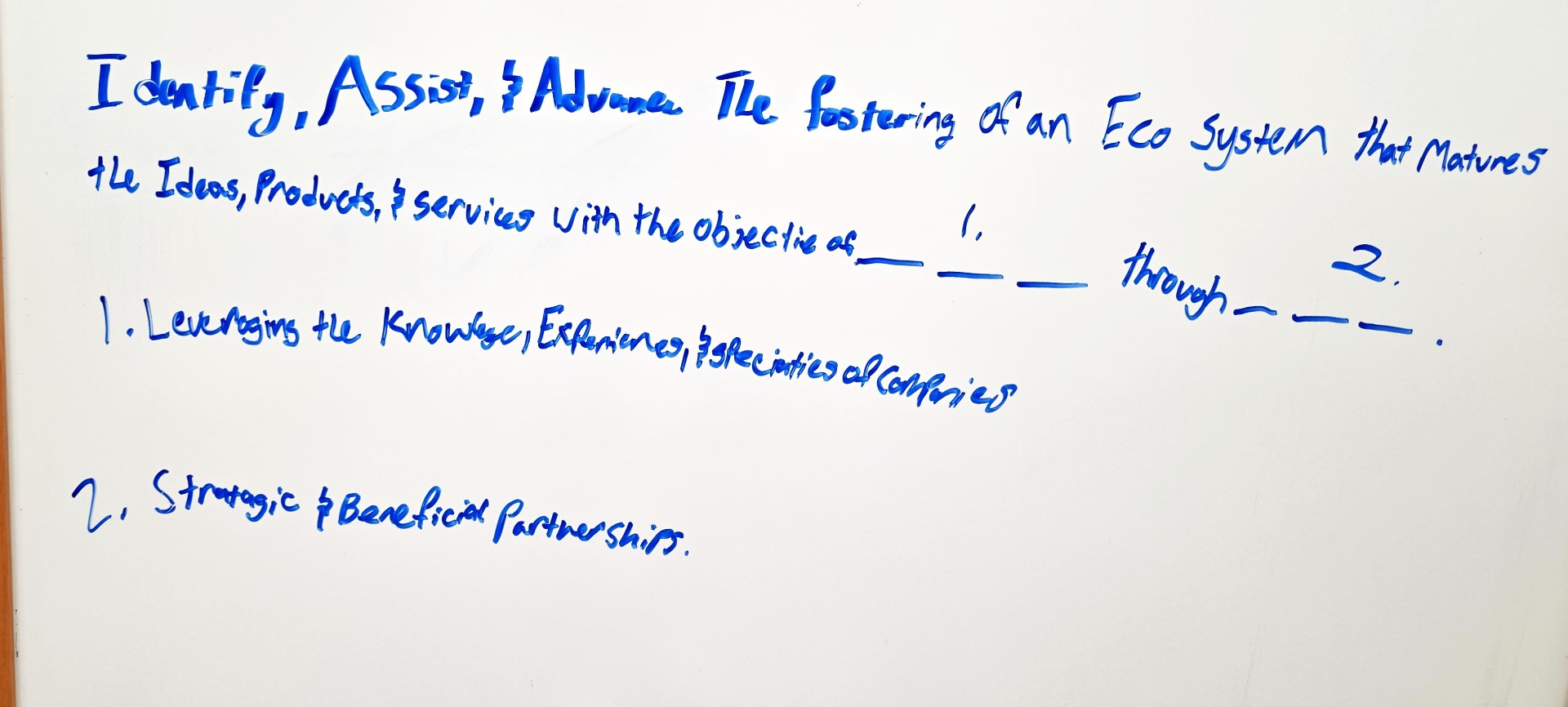
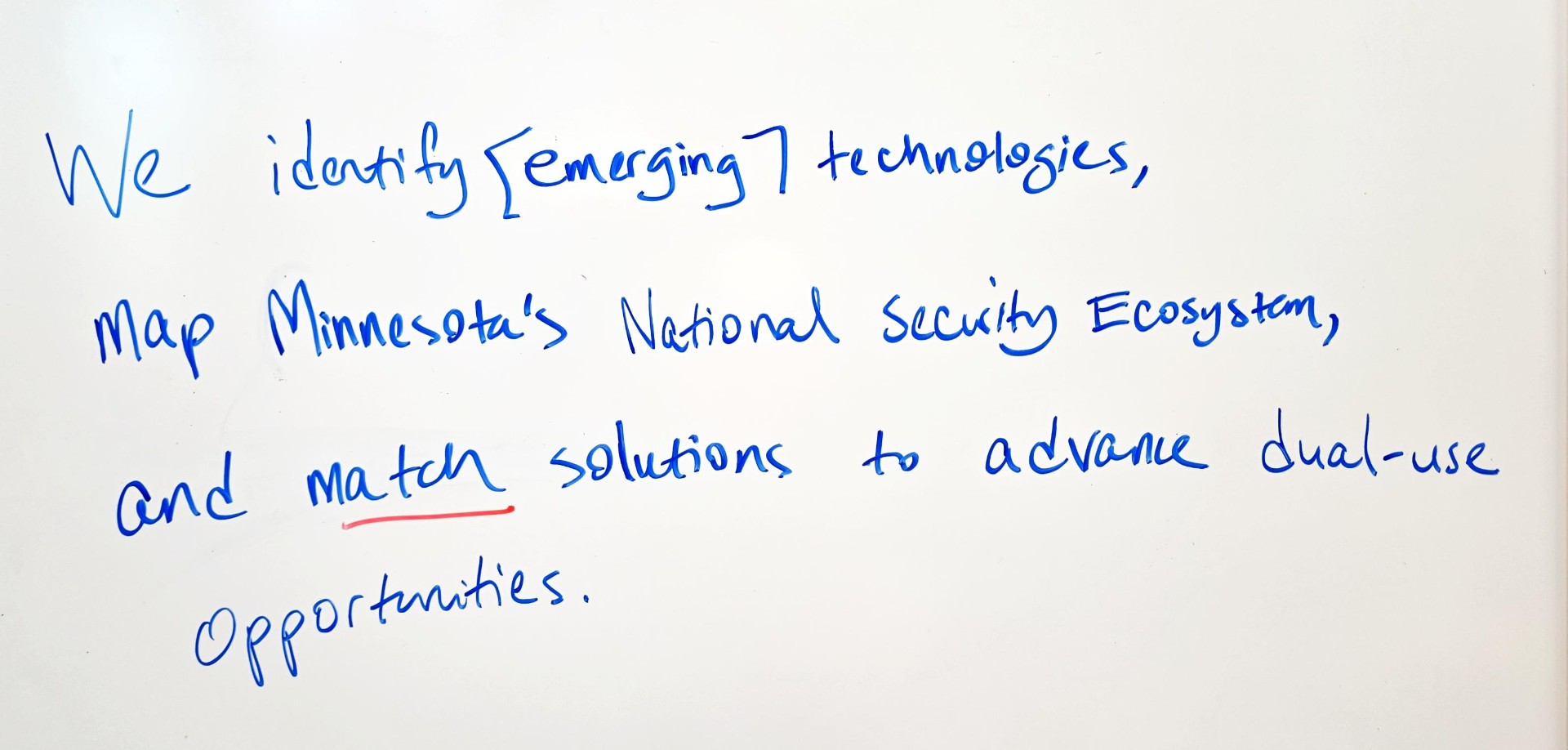
Photos of the Purpose, Vision, and Mission development captured during the session.
Draft Purpose Statement Options
Candidate statements drafted from the group discussion.
- 1
Option 1
To identify, assist, advance, and promote Minnesota's commercial technologies to meet national security needs while creating regional economic opportunities.
Influence & Context: This option is built directly from the structural framework developed by the team on the whiteboard (Identify/Map, Assist/Match, Advance/Mature, Promote/Advocate). It explicitly rejects the high-level generic statement handed down by national programs—such as "accelerating adoption"—because the team noted they cannot control final procurement decisions. Instead, it anchors the hub's foundational "why" in realistic, day-to-day actions the local operators can execute and measure.
- 2
Option 2
To serve as a clear connector and interpreter that bridges the gap between Minnesota's commercial industries and security needs, making complex public markets accessible for local companies.
Influence & Context: This option reflects the team's detailed discussion about the deep gap that exists between defense agencies and commercial innovators. Because Minnesota lacks a major active-duty military base, local businesses often find the federal system intimidating or confusing. This statement positions the hub as an interpreter whose primary reason for being is to strip away dense military acronyms, sanitize the vernacular, and make the system understandable for everyday commercial founders and local public leaders.
- 3
Option 3
To revitalize Minnesota's historical strength as a premier technology base by matching local commercial innovations with critical needs that protect communities, support service members, and preserve peace.
Influence & Context: This option captures the historical and emotional focus of the whiteboard session, where the group discussed restoring Minnesota's legacy as an engineering powerhouse (recalling the days of early computing, 3M, and Honeywell). It coordinates the hub's purpose with the personal motivations of the operators—such as a passion for saving lives and a whole-of-society approach to national resilience—proving that defense innovation is ultimately about economic growth, local pride, and keeping people safe.
Draft Vision Statement Options
Candidate statements drafted from the group discussion.
- 1
Option 1
A thriving network where Minnesota's commercial technology sector is a recognized leader in providing the innovations needed to protect the nation and grow the state's economy.
Influence & Context: This option is driven by the team's discussion on balancing proud regional visibility (the "Texas model" of advertising the state) with Midwestern humility ("humbly solving the world's problems"). It directly frames the hub's long-term goal around the core operational philosophy shared by the team: that national security work is fundamentally about protection, preserving peace, and revitalizing the local industrial base.
- 2
Option 2
A clear national model for how commercial ingenuity connects to federal needs, making Minnesota a permanent, relevant part of the machinery that builds national security.
Influence & Context: This option draws directly from the five-year vision text shared from the Twin Cities Business Magazine interview and the whiteboard notes under "Why do we want to exist?". It captures the team's desire to overcome the state's historical isolation from federal defense funding ("flyover country" bias) by creating a visible, structured ecosystem that gives local companies a reliable pathway to national opportunities.
- 3
Option 3
The nation's destination for building, testing, and scaling dual-use technologies, where federal partners come to leverage Minnesota's strengths in manufacturing, medicine, and autonomous systems.
Influence & Context: This option is heavily shaped by the final session detailing the hub's specific technical campaigns and horizontal capabilities. It looks past everyday matchmaking to envision a future where major physical developments—like the Minnesota Aerospace Complex and the Lake Superior drone test ranges—turn the state into a national "magnet" for testing and validating advanced commercial hardware and software.
Draft Mission Statement Options
Candidate statements drafted from the group discussion.
- 1
Option 1
We identify emerging technologies, map Minnesota's national security ecosystem, and match local commercial solutions to fill critical defense needs.
Influence & Context: This option is pulled directly from the final blueprint written on the whiteboard during the purpose session. It defines the day-to-day tactical workflow that the team can directly execute and control (identifying, mapping, and matching) rather than focusing on long-term macro outcomes like final procurement or technology adoption, which rely on outside federal authorities.
- 2
Option 2
We lower market barriers for commercial companies by translating complex defense requirements, uncovering regional capabilities, and guiding local innovators through the defense entry process.
Influence & Context: This option is heavily influenced by the team's discussion about acting as an "interpreter" between the commercial sector and the military. It addresses the reality that Minnesota lacks a large active-duty base presence and that many local founders shut down when faced with dense military jargon. This mission focuses the team's day-to-day work on demystifying the system, simplifying communication, and protecting private company data.
- 3
Option 3
We build a durable pipeline of regional technologies—focusing on advanced manufacturing, medical tech, cold weather innovation, autonomy, and testing infrastructure—to accelerate practical solutions for our mission partners.
Influence & Context: This option stems from the final session where the team drew a hard operational line to prioritize five specific focus areas for the next 365 days. It is a pragmatic, operator-focused statement that keeps the team from spreading themselves too thin. By directly referencing the specific campaigns, it gives the hub a clear blueprint for where to conduct market research and host targeted matchmaking events.